Sunday, October 30, 2011

Installing a 2.5" Laptop Drive into an Empty Floppy Drive Bay

My company decided to standardize our computers more than previously. For Desktop computers, this meant the Dell Optiplex 980. These have full-size DVD drives, but otherwise no extra room for extra hard drives.
Being a tech, I needed more "working space" than a regular computer, plus I wanted extra local storage to blow away my C: drive and re-image on a whim. So I decided to try installing a laptop drive into the empty floppy drive bay. That really was the only choice inside the crapped case.
I took the steel floppy drive blank filler home and carefully marked and drilled three holes for mounting. Then I cleaned the holes up.
Back at work, I grabbed three rubber pointer nubs - those extras that come with laptops in case you need to replace the little finger nub in the middle of the keyboard that no one seems to use. Quite a few of them have accumulated over the years. I drilled them out so that a screw would fit through them. These were my shock-mounts.
Last, I chose three longer screws so that they would bottom-out inside the threaded holes in the hard drive case. This is so the screws would resist unscrewing. Since I was using shock-mounts, I wouldn't be able to screw the hard drive rigidly against the steel bay, so the screws either needed Locktite or they needed to bottom-out.
It was a quick and easy project.


Tuesday, May 3, 2011

Simple Sysprep for Enterprise

I've already posted about eSATA, and how once you've built your PC with the wrong BIOS setting, then changing the BIOS will cause a BSOD. The answer was to Sysprep the machine and then change the BIOS. If your computer is fully built, you'll want the least damage done to your computer. Basically, you just want to rip the hardware profile out so that it rebuilds on the next reboot.
Through much trial-and-error, I came up with the following two-part system.

A script, SysprepLaunch_x64.cmd, that contains only the following...
net stop wmpnetworksvc
sysprep /generalize /oobe /shutdown /unattend:unattend_x64.xml


I stumbled across a few posts where they found that the Windows Media Player sharing service can ruin Sysprep, so I start by stopping the service. Then I launch Sysprep, calling the answer-file.

The answer-file was the hard part.
The answer-file below is for x64 only. To tailor it for x86, simply replace processorArchitecture="amd64" with processorArchitecture="x86".

The unattend_x64.xml answer-file

<?xml version="1.0" encoding="utf-8"?>
<unattend xmlns="urn:schemas-microsoft-com:unattend">
<settings pass="windowsPE">
<component name="Microsoft-Windows-International-Core-WinPE" processorArchitecture="amd64" publicKeyToken="31bf3856ad364e35" language="neutral" versionScope="NonSxS" xmlns:wcm="http://schemas.microsoft.com/WMIConfig/2002/State" xmlns:xsi="http://www.w3.org/2001/XMLSchema-instance">
<SystemLocale>en-us</SystemLocale>
<UserLocale>en-us</UserLocale>
<UILanguage>en-US</UILanguage>
<UILanguageFallback>en-us</UILanguageFallback>
<InputLocale>0409:00000409</InputLocale>
</component>
<component name="Microsoft-Windows-Setup" processorArchitecture="amd64" publicKeyToken="31bf3856ad364e35" language="neutral" versionScope="NonSxS" xmlns:wcm="http://schemas.microsoft.com/WMIConfig/2002/State" xmlns:xsi="http://www.w3.org/2001/XMLSchema-instance">
<UserData>
<ProductKey>
<Key><span style="font-weight:bold;">XXXXX-YOUR-WIN7X-KEYXX-XXXXX</span></Key>
<WillShowUI>OnError</WillShowUI>
<!-- <WillShowUI>Never</WillShowUI> -->
</ProductKey>
<Organization>Loose Screw</Organization>
<FullName>Administrator</FullName>
<AcceptEula>true</AcceptEula>
</UserData>
</component>
</settings>
<settings pass="oobeSystem">
<component name="Microsoft-Windows-Deployment" processorArchitecture="amd64" publicKeyToken="31bf3856ad364e35" language="neutral" versionScope="nonSxS" xmlns:wcm="http://schemas.microsoft.com/WMIConfig/2002/State" xmlns:xsi="http://www.w3.org/2001/XMLSchema-instance">
<Reseal>
<Mode>OOBE</Mode>
</Reseal>
</component>
<component name="Microsoft-Windows-Shell-Setup" processorArchitecture="amd64" publicKeyToken="31bf3856ad364e35" language="neutral" versionScope="nonSxS" xmlns:wcm="http://schemas.microsoft.com/WMIConfig/2002/State" xmlns:xsi="http://www.w3.org/2001/XMLSchema-instance">
<OOBE>
<ProtectYourPC>1</ProtectYourPC>
<NetworkLocation>Work</NetworkLocation>
<HideEULAPage>true</HideEULAPage>
</OOBE>
<TimeZone>Mountain Standard Time</TimeZone>
<AutoLogon>
<Password>
<Value>h@rdpa$$w0rd</Value>
<PlainText>true</PlainText>
</Password>
<Username>Administrator</Username>
<Enabled>true</Enabled>
<LogonCount>5</LogonCount>
</AutoLogon>
<UserAccounts>
<AdministratorPassword>
<Value>h@rdpa$$w0rd</Value>
<PlainText>true</PlainText>
</AdministratorPassword>
<LocalAccounts>
<LocalAccount wcm:action="add">
<Password>
<Value>PASSWORD HERE</Value>
<PlainText>true</PlainText>
</Password>
<Name>PC Central</Name>
<Description>Local Administrator</Description>
<DisplayName>IT Central</DisplayName>
<Group>Administrators</Group>
</LocalAccount>
</LocalAccounts>
</UserAccounts>
<OEMInformation>
<Manufacturer>Dell</Manufacturer>
<HelpCustomized>false</HelpCustomized>
<SupportURL>http://support.dell.com/support/index.aspx?c=us&cs=04&l=en&s=slg</SupportURL>
</OEMInformation>
<FirstLogonCommands>
<SynchronousCommand wcm:action="add">
<Description>Activate Windows 7</Description>
<CommandLine>"cscript C:WindowsSystem32slmgr.vbs -ato"</CommandLine>
<Order>1</Order>
</SynchronousCommand>
</FirstLogonCommands>
</component>
<component name="Microsoft-Windows-International-Core" processorArchitecture="amd64" publicKeyToken="31bf3856ad364e35" language="neutral" versionScope="nonSxS" xmlns:wcm="http://schemas.microsoft.com/WMIConfig/2002/State" xmlns:xsi="http://www.w3.org/2001/XMLSchema-instance">
<InputLocale>en-us</InputLocale>
<SystemLocale>en-us</SystemLocale>
<UILanguage>en-us</UILanguage>
<UILanguageFallback>en-us</UILanguageFallback>
<UserLocale>en-us</UserLocale>
</component>
</settings>
<cpi:offlineImage cpi:source="wim://SERVER1/install.wim#Windows 7 ENTERPRISE" xmlns:cpi="urn:schemas-microsoft-com:cpi" />
</unattend>

Friday, April 22, 2011

Configuring Virtual Machines and Hosts

Last time, I covered setting up Windows 7 to run XP virtual machines. What came next was figuring out how to setup VirtualPC optimally.

First, make sure that Virtualization Technology is enabled in your BIOS, if such a setting exists. Without it, VirtualPC can't take full advantage of the host's hardware if this is not enabled. This would mean you can't run CAD, GIS, or play games, which need a closer relationship to available hardware. Since nearly everything to do with hardware is "emulated", hardware intensive apps won't run on VirtualPC without Virtualization Technology enabled.

Memory
The goal is to have enough memory for both the host and the VM, while minimizing paging operations. Robbing the host of too much memory is worse than robbing the VM. So the host should get the priority. If the host is slowed down, it will slow the VM down, so there’s no winning way to give a VM very much more than it will ever need.
1. First, log onto the host and launch all the applications you’re used to running. Let all initial processing (AV def update, AV initial scan, email sync with server, etc.) finish until the computer comes to rest.) You might want to launch maybe one or two more apps, especially if there’s an app you use maybe once every day, even if you don’t leave it running all the time. Especially launch any memory-hogs you use regularly.
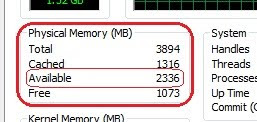
2. Bring up Task Manager and go to the Performance tab. Look at the bottom under Physical Memory and note how much memory is available.

In this example, we have 2336MB.
Now subtract about 200MB for additional applications. This totals 2136MB available (max.) for the VMs to use.
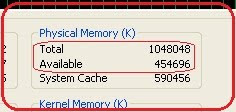
3. Repeat this process for each virtual machine, but don’t just record “Available” – figure out how much is used.


In this example, the VM has been pre-configured on the host to allow 1024MB of memory to the VM. It is only using 593.3MB (1048048 – 454696 = 593352). Add ~35MB for additional applications. The VM actually needs 629MB.

Adding additional memory, above what your VM needs, will not speed it up. It will only allow you to run more applications. Most VMs are dedicated to 1-3 specific legacy applications, and no more. So it is best to allot barely more than the minimum. If your VM becomes sluggish, you might want to double-check your VM memory usage as time goes on. Newer versions of applications usually use additional memory, as the trend is towards code-bloat. If your host has more than enough memory, you might want to allow your VMs 100-200MB more, to allow for memory-hogging upgraded applications, like newer versions of IE, new OS Service Packs, etc.) as the years go by. This way you’re not hassled with VM configuration maintenance in the future.

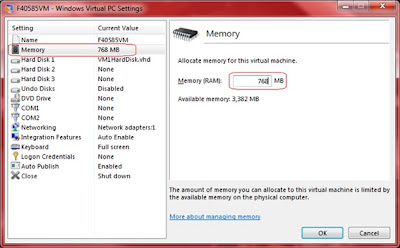
4. So the last step is to reconfigure Virtual PC. Since 4GB on the host is a healthy quantity, I rounded 629MB upward to ¾ of a gig. I changed 1024MB to 768MB.


After making the change, and launching my VM, I see the host still has just over 1702MB available. The VM still has 203MB available.

Networking
- Dual NICs
Some machines have more than one NIC available. Our Server group advises against this practice, as it has caused issues with DNS and/or AD. However, it is possible to configure your host to use one NIC exclusively, while configuring your VM to use the other exclusively.
Since our Server group advises against dual NICs, I will only mention it, not detail the steps, since I don't have experience with it.

- No NIC Found
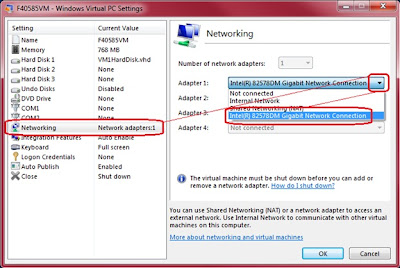
If your VM can’t find an available NIC, then make sure you have the latest version/patch-level of Virtual PC and that “Integration features” are enabled.
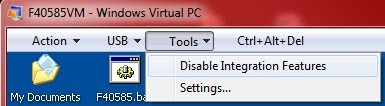


Then make certain the appropriate host computer’s NIC is selected in the VM settings…


"Turn off" versus "Shutdown"
“Turn off” is not accurate. This term refers to yanking the power cord. This is only good if the VM is attacked by a virus, or a similar panic situation.
“Shutdown” is a normal, controlled shutdown, where any open apps will be closed, and temporary files released.

Slow Explorer Access Between host and VM
There’s a problem with some VMs copying files from the host hard drive – phenomenally slow. There are a few possible fixes…

Method 1
The 1st method is for servers, not clients. Follow the hyperlinked text above if you want the details.
Method 2
Disable TCP task offloading in the registry of the host computer. To do this, add the following value.
[HKEY_LOCAL_MACHINE\SYSTEM\CurrentControlSet\services\Tcpip\Parameters]
"DisableTaskOffload"=dword:00000001
Restart your computer for it to take effect.
Method 3
Most NICs don’t have the choices detailed in Method 3, so don’t be surprised if Method 2 is the only one available.
If you do not want to disable TCP segmentation offloading on the whole system, and you want to only disable TCP segmentation offloading on the network adapters that Virtual Server guests use, you must not add the DisableTaskOffload registry entry that is described in Method 2. Instead, you can disable the task offload properties on the Advanced tab of the Properties dialog box of the network adapter.

To disable the task offload properties, follow these steps:
1. Click Start, click Run, type ncpa.cpl, and then click OK.
2. Right-click your network adapter, and then click Properties.
3. Click the General tab, and then click Configure.
4. Click the Advanced tab.
5. In the Property box, click the Offload TCP Segmentation property.
6. In the Value list, click Off, and then click OK.
7. If you also have the following task offload properties in the Property box, you must repeat step 5 to step 6 to disable these properties:
o Offload Receive IP Checksum
o Offload Receive TCP Checksum
o Offload Transmit IP Checksum
o Offload Transmit TCP Checksum
Sysinternals has a Secure-Delete utility that some say improves performance of VM’s. I’m not sure how or why it would, but for what it’s worth, they say to run the switch to clean empty space on the host hard drive where the VM’s VHD resides…
:: usage: sdelete [-p passes] [-s] [-q]
:: sdelete [-p passes] [-z|-c] [drive letter]
:: -c Zero free space (good for virtual disk optimization)
:: -p passes Specifies number of overwrite passes (default is 1)
:: -q Don't print errors (Quiet)
:: -s Recurse subdirectories
:: -z Clean free space
sdelete.exe -c C:

Hard Drives

It will give better performance for both the host and VM if the VM is on a different physical drive from the host OS. This is often not possible, but it is more ideal.
This may not be true for external drives – it depends on the overall data-rate. Alleged speeds are never reached, and some connections may be running at 1/20th the rated speeds, for whatever reason. Running from a mapped network drive is a very bad idea.
It’s also good to keep disc fragmentation to a minimum, on both the host and the VM.

Virtual PC and XPMode

Many of you may work in a corporate environment with Volume Licensed Mircosoft products. Moving to Windows 7 from Windows XP (nearly every company skipped Vista) can be difficult. The biggest headache is compatibility. The solution is often to include a Windows XP virtual machine with every new Windows 7 machine.

Installing
Install Virtual PC first, either x86 or x64 for your OS type...
Windows6.1-KB958559-x64-RefreshPkg.msu
Windows6.1-KB958559-x86-RefreshPkg.msu

Then install Windows XP Mode...
WindowsXPMode_en-us.exe

Update for Windows XP SP3 to enable RemoteApp (install on your VM)...
KB961742-v3.exe

The first one is installed into Windows 7 to allow you to run a virtual machine. WindowsXPMode allows you to create a Windows XP virtual hard drive with Windows XP on it, and then to run applications inside the XP VM without manually launching VirtualPC.
This is a big download because the Windows XP CD is included within the installer. Every Vista and Windows 7 install comes with a Windows XP license at no extra charge. Microsoft did this to allow you to work around compatibility issues. When all else fails, run in from a virtual machine.

Copying your Volume Licensed XP Virtual Machine
In a corporate environment, with Volume Licensed products, there's a problem. The WndowsXPMode VHD that gets created automatically is an OEM license, not a VL license. So in a corporate environment, don't bother going through the XPMode wizard to create the image. You'll have a production-line of new computers anyway.
So one problem is your license, but another is that each VM has to be set up the way real, physical machines are set up, if they are going to be 100% functional. Our domain has quite a few web-based systems everyone needs access to. Some don't yet work with IE8, much less IE9. Some don't work on Windows 7. Many server-based applications automatically grab the logged-on user's credentials. This means an OEM license is not legal, and your VM will have to be joined to the domain like a real machine. So you need to build a VHD/VM using your Volume Licensed copy of Windows XP. Every Windows 7 machine will have to have Virtual PC and WindowsXPMode installed, and you'll have to copy your XP VM to every new Windows 7 machine.

I've decided, since multiple users sometimes use one machine, that I would store the VHD here: D:\VirtualMachines\WinXPMode\WinXPMode.vhd

Microsoft designed Virtual PC in a clunky per-user manner, storing the VHD within profiles. To me, this is crazy. On a multi-user computer, this means every user gets their own separate VHD that is several gigabytes in size! This might even be a license violation, since each Vista or Win7 machine is only allowed one XP license. But that depends on the fine-print (since only one person at a time can actually use a computer, only one VM will be running).
I move it to the D: partition where everyone can get to it.
Unfortunately, every user who logs on has to run the VPCWizard located here...
C:\Windows\System32\VPCWizard.exe
And Microsoft didn't bother to create a menu shortcut for you (did they really think this through?)

Setting up your XP VM
I unplug the network wire on my Win7 host machine and launch the VM. I run Sysinternals' NewSID (sorry folks, this is no longer included within Sysinternals' package because it ruins Windows 7 and Vista. Maybe you can still find it somewhere else? Or use something else.
I rename the VM the same as the computername, but with an extra "VM" tacked onto the end. That way, when looking at computers on a domain, and you see \\Q123456 and \\Q123456VM, you know the the latter is a VM being hosted by the former.

After the VM reboots with a new SID and name, I join it to the domain.
Every new user added to the VM has to run VPCWizard to create individual *.vmc and *.vmcx files. These will be stored in the individual user Profiles pointing at the common VHD on the D: drive.

Thursday, February 24, 2011

This is Why I didn't Buy WP7 Yet

10% failure rate of Windows Phone 7 device

If I buy a WP7 phone, it must already have copy-paste capability.
This roll-out is the first one, too, so everyone is a beta tester, whether they intended to be or not.

Saturday, February 12, 2011

AT&T, iPhone, and Verizon

I used to use a Windows smartphone. It did everything I wanted, from spreadsheet creation, cell formulas, Word docs, Internet, texting, and had great service.
Problem was it was analog and analog services were being turned off nationwide. I was forced to switch. Add to that, Cingular got bought by AT&T.
AT&T has always been good at marketing. Grab that customer. The problem was as soon as they have you under contract, they don't give a rats ass about you. They started turning off the digital network for my 1st-gen iPhone.
That's another story... I shopped a LOT! I saw so many posts claiming the iPhone was the "perfect phone". I couldn't do spreadsheets, I never could use the 8GB drive space. "Oh, just jailbreak it." Get real. I don't have time to dink with my phone all the time. Apple fanboys are the most disconnected-from-practical-reality of any creatures on earth. Take reviews with a grain of salt.
Add to the list, AT&T had a monopoly on the iPhone. They could treat you like a floormat, and then say, "Upgrade your phone! Just sign here to renew your contract for another three years."
How's that saying go? Fool me once, shame on you Fool me twice...
So I refused to upgrade, sign, jailbreak, etc. Instead, I've eagerly anticipated the new Windows Phone 7. Unfortunately, it's no better than an iPhone! (I'm not a Windows fanboy, either.) At least it'll do my Office apps, but it's locked-down and restrictive just like an iPhone. Can't carriers just give us what we want without [explitive omitted] with us? WP7 was supposed to be out in September. Then by Thanksgiving. Then before year-end. Then the copy&paste update was supposed to follow early January. Then late Jan. Then Feb. Now March...
Geez.
This whole time, I'm limping by with my crappy iPhone, cuz why replace my current crap with new crap? If I can't get what I want, why bother changing?
Now I'm noticing, since Verizon now offers the iPhone, and Verizon got SWAMPED with buyers (not AT&T), I've noticed that the dead-spots here in Denver are getting service again! AT&T is now caring about customers! See what a little competition does? Exclusive phone offerings should be illegal. Corporate monopolies are illegal. Product monopolies should also be illegal.

Wednesday, February 9, 2011

Check for Caps-Lock in Batch Script

For years, I've had to access restricted network shares, most often when logged on with either local-computer credentials, or as an end-user who doesn't have permission to access the share. So I fire off a script that passes my credentials.

It really sucks when they have caps-lock on, and I don't know it, and lock myself out. Scripts are good about doing that. Since a script can store your credentials and pass it to several different shares, you can get locked out in a split second. You don't have to type your password wrong manually three times.

With 32-bit Windows, there is an old 16-bit executable that can check this. It's called debug.exe, and Microsoft stores it in the wrong place (they do that a lot).
C:\Windows\system is supposed to hold legacy 16-bit files. C:\Windows\System32 holds 32-bit files. So guess where they stuck it? They stuck the 16-bit debug into System32. (It's the Microsoft way.)
Debug.exe won't function on a 64-bit computer, no matter how you try to trick WOW (Windows-On-Windows) into handling it.

Copy the code below and save it in a text file and name it anything ending in .bat or .cmd. Then fire it off with caps-lock either on or off to see the difference.
I've tried it successfully on Windows XP and Windows 7 32-bit. (Beware line-wrapping.)


TITLE DOMAINAPPS tech-share
echo off

:: Check for caps-lock on...
set capslock=0
for /f "skip=1 tokens=2" %%a in ('(echo d0:417,417 ^&echo q^) ^|debug') do IF %%a GEQ 40 SET capslock=1
if %capslock% == 1 cls&echo.& echo CAPSLOCK IS ON!!& color cf& echo.& pause

:: Prompt for username...
cls&echo.&color 1f
set /p useris=Type Your Username:

:: Now pass your credentials...
color 9f
net use \\OurDomain.net\DOMAINAPPS /user:%useris%OurDomain.net
:: And open the share...
explorer \\OurDomain.net\DOMAINAPPS


For x64 Windows, I resort to using Powershell instead of debug.exe. This has the added advantage of working on both 32-bit and 64-bit.
The following code should work, even if a bit slower. (Note that I like to leave Powershell script security on "Restricted", and drop it just-in-time for my command, then raise security back up immediately afterward.)


TITLE DOMAINAPPS tech-share
echo off

:: Check for caps-lock on...
set capslock=0
powershell -command "& {Set-ExecutionPolicy Unrestricted -force}"
for /f "tokens=*" %%a in ('powershell -command [console]::CapsLock') do set capslock=%%a
:: Return the security policy to default, restricted.
powershell -command "& {Set-ExecutionPolicy Restricted -force}"
if %capslock% == 1 cls&echo.& echo CAPSLOCK IS ON!!& color cf& echo.& pause

:: Prompt for username...
cls&echo.&color 1f
set /p useris=Type Your Username:

:: Now pass your credentials...
color 9f
net use \\OurDomain.net\DOMAINAPPS /user:%useris%OurDomain.net
:: And open the share...
explorer \\OurDomain.net\DOMAINAPPS

Tuesday, February 8, 2011

How to Get eSATA to Work

I've had a hell of a time trying to figure out eSATA. My first post mentioned my 32GB Kanguru flash drive that worked on one computer for two weeks and then stopped.
I bought a new computer - obnoxiously fancy - capable of everything and including three eSATA ports. So far, none of them have worked.

I bought a SATA hard drive dock that had both USB2.0 and eSATA, but only the USB2.0 ever worked.

At work, my 2TB LaCie Firewire drive has been failing. It keeps dropping offline. To keep from Blue-Screening, I have to delete it from Device Manager and then unplug it, then re-plug it and wait for it to reinitialize. It's been happening about six times a day. That gets old!

So I bought a nifty little 5-drive AMS RAID box that uses 2.5" laptop drives.

It has USB3.0 and eSATA interfaces. Since computers mostly don't come with USB3.0 yet, I decided to give eSATA one last chance.

Google showed me that there are tons of techies out there who can't get eSATA working, so it wasn't just me.
Here's the deal... the marketing departments virtually lie. Manufacturers know that if they put eSATA on a motherboard, they'll sell more computers, but they don't tell you you can't have both internal RAID 5 and eSATA.

AHCI is a SATA mode required for hot-swapping SATA drives. This is very desirable if you intend to use an eSATA device like a USB flash drive. Yanking an eSATA device out without hot-swap capability will crash your computer, and can damage the device.
When you buy a fancy motherboard that can do anything, they don't tell you that of all the drive options it allows, you can choose only one. My Asus motherboard has a 4-drive RAID 5 main drive, but if you turn on RAID 5, you can't use AHCI mode, so none of my eSATA ports work.
Allegedly, AHCI isn't required for eSATA to work - only for hot-swapping. So allegedly you can still use eSATA if you turn off your computer, plug in your eSATA device, and boot cold. But in reality-land, hardly anyone can get eSATA to work unless AHCI is turned on. And it never seems to be "on" by default.

At work, to get my 2250C mini to work on a Dell Optiplex 980 with Windows 7 x64, I checked the BIOS. Unfortunately it was set to SATA-RAID-ATA. I changed it to SATA-RAID-AHCI and the computer became unbootable and even a repair wouldn't work. So I put it back to ATA, dis-joined it from the domain, and ran Sysprep. Sysprep ripped the entire hardware and drive configuration out and turned-off the machine. Then I set the BIOS to AHCI and booted. Windows built back up and booted fine.
So if you've tried changing the BIOS SATA settings and failed on an in-place machine, Sysprep can be your salvation.

Next, I downloaded the latest BIOS flash, Intel chipset drivers, and AHCI drivers and installed them all. Previous to getting the BIOS set to AHCI, the AHCI drivers wouldn't install. The attempt only told me "computer does not meet minimum specs". But with the correct BIOS setting, the drivers went right on.

Then I installed the RAID management utility. When I plugged my RAID box in, it was easy to set it to RAID 5 and build the array. Then in Windows Disk Management, I formatted NTFS and was done. Five drives, 2TB, and almost palm-sized. Freakin' cool!

Too bad the 32GB Kanguru still doesn't work on the eSATA end. It has always worked on the USB end, and it's still one of my favorite flash drives. Only thing is, the Kanguru dumps regularly. The partition tables or something keep vanishing and all the data on it goes bye-bye. If I kept vital data on it, this would piss me off, but I just have a backup script that I run to snatch loads of the most important personal work files off my work computer to take home and dump on my 5.5TB Drobo. So the data doesn't have to live long, and the script is backed-up.

So here I am with another almost built computer sitting on the floor at home and seeing that I want RAID 5, but also want all the eSATA ports to work, I guess the thing to do is use Solid State Drives. They're faster than RAID 5. You can also get SSD's that fit into PCIe slots, and I can attach a RAID 5 box on the outside, via eSATA. As long as the RAID 5 isn't internal, you can still use it.

Saturday, April 17, 2010

Published!

I guess WindowsITPro Mag is going to publish one of my letters. I don't like paper, so I probably won't see it. Apparently it had something to do with my last blog post. They like when someone reads one of their guru's posts and then takes the ball and runs with it. That's the whole point of what they're trying to do.

These days, it seems that the general population of techs rely solely on "tools". Not many know how to write any code at all - not even batch. Much of it is laziness, but also there's Wally Syndrome. Fact is, most corporations are so political, the more you do the more likely you are to get in trouble. Most would rather keep their heads down and mouths shut, and coast along doing the minimum - just like Wally in the Dilbert cartoon. Sometimes I completely understand, because sometimes people are punished for doing a good job. That's the way corporate politics often work, all over the world.
I'm just driven, though. I don't think of my one job as being the end-all. Jobs are just opportunities. If we try to excel, we become better each day and more employable. So if it didn't work out at one place, for whatever reason, and you are diligent at becoming a better person, your viability is assured. I'm not saying life will be guaranteed as easy. Life is dynamic and you have to be dynamic in order to survive. Your skills and mindset need to be dynamic.

Sunday, March 7, 2010

Checking For Updates

There are quite a few free utilities, add-ins, plug-ins, etc. that are either ubiquitous or at least my own preference to have on all computers. Keeping track of updates was a royal pain. Sometimes I'd get so busy for so long I'd neglect checking for months.
I wanted a script that checks Internet sites for updates rather quickly. I figured PowerShell would give me the power to do it. I finally found the code from Alex Angelopoulos at
WindowsITPro, but I'm not sure anyone thought to use it the way I wanted.
I prefer to leave my PowerShell security at the default level, which is to disable scripts from running. I use an old-fashioned CMD script as a wrapper-script to write my script, lower security, run the script, and finally delete the script and raise security back up.
The script requires maintenance, but it sure beats the old haphazard way. I edit the version-levels for each product to keep them current. The script checks the host web-page, tries to look for a version string, and if it can't find it, it is assumed the version has either changed to a newer one, or the version can no longer be found.

Some web-pages confound all my efforts to find a version I can query. That's because they have some very intricate layers of web-sites working together that make them hard to hack. I'm not trying to hack them - just query them - but their security precautions have made it impossible for me to check Apple's or Adobe's sites. The others are pretty straight-forward.
As usual, watch out for text-wrapping in the code window.


:: Allow PS scripts to run
powershell -command "& {Set-ExecutionPolicy -Scope LocalMachine Unrestricted -Force}"

:: Create Powershell script (from Alex K. Angelopoulos, WindowsITPro)
:: http://windowsitpro.com/article/articleid/99844/use-the-net-webclient-class-in-powershell-scripts-to-access-web-data.html
@echo Param( > ".\Get-WebString.ps1"
@echo [string]$Uri, >> ".\Get-WebString.ps1"
@echo $Encoding = "Default" >> ".\Get-WebString.ps1"
@echo ) >> ".\Get-WebString.ps1"
@echo $WebClient = New-Object System.Net.WebClient >> ".\Get-WebString.ps1"
@echo $WebClient.Encoding = [System.Text.Encoding]::$Encoding >> ".\Get-WebString.ps1"
@echo $WebClient.DownloadString($Uri) >> ".\Get-WebString.ps1"

:Sun Java Update 18
powershell -command ".\Get-WebString.ps1 http://www.java.com/en/download/manual.jsp" | find /i "Version 6 Update 18"
if %errorlevel%==0 goto :Diskeeper
"C:\Program Files\Internet Explorer\IEXPLORE.EXE" http://www.java.com/en/download/manual.jsp

:Diskeeper
powershell -command ".\Get-WebString.ps1 http://www.diskeeper.com/Diskeeper/update-patch/update-patch.aspx" | find /i "Build-900"
if %errorlevel%==0 goto :Firefox
"C:\Program Files\Internet Explorer\IEXPLORE.EXE" http://www.diskeeper.com/Diskeeper/update-patch/update-patch.aspx

:Firefox
powershell -command ".\Get-WebString.ps1 http://www.mozilla.com/en-US/firefox/ie.html" | find /i "US/firefox/3.6"
if %errorlevel%==0 goto :doPDF
"C:\Program Files\Internet Explorer\IEXPLORE.EXE" http://www.mozilla.com/en-US/firefox/ie.html
:: http://wiki.mozilla-x86-64.com/Firefox:Download

:doPDF 7.1.330
powershell -command ".\Get-WebString.ps1 http://www.dopdf.com/" | find /i "7.1.330"
if %errorlevel%==0 goto :Paint.NET
"C:\Program Files\Internet Explorer\IEXPLORE.EXE" http://www.dopdf.com/

:Paint.NET v3.5.4
powershell -command ".\Get-WebString.ps1 http://www.getpaint.net/" | find /i "v3.5.4"
if %errorlevel%==0 goto :IZArc
"C:\Program Files\Internet Explorer\IEXPLORE.EXE" http://www.getpaint.net/

:IZArc
powershell -command ".\Get-WebString.ps1 http://www.izarc.org/download.html" | find /i "4.1"
if %errorlevel%==0 goto :CPU_Z
"C:\Program Files\Internet Explorer\IEXPLORE.EXE" http://www.izarc.org/download.html

:CPU_Z
powershell -command ".\Get-WebString.ps1 http://www.cpuid.com/cpuz.php" | find /i "Z 1.53"
if %errorlevel%==0 goto :burnaware_free
"C:\Program Files\Internet Explorer\IEXPLORE.EXE" http://www.cpuid.com/cpuz.php

:burnaware_free
powershell -command ".\Get-WebString.ps1 http://www.burnaware.com/downloads.html" | find /i "2.4.4"
if %errorlevel%==0 goto :DeepBurner
"C:\Program Files\Internet Explorer\IEXPLORE.EXE" http://www.burnaware.com/downloads.html

:DeepBurner
powershell -command ".\Get-WebString.ps1 http://www.deepburner.com/?r=download" | find /i "DeepBurner Free 1.9"
if %errorlevel%==0 goto :ImgBurn
"C:\Program Files\Internet Explorer\IEXPLORE.EXE" http://www.deepburner.com/?r=download

:: It's longer, but I'm truncating many sections. You can extrapolate from here.
:: So on to the ending...

:END
del /q ".\Get-WebString.ps1"

:: Raise PS security back up
powershell -command "& {Set-ExecutionPolicy -Scope LocalMachine Restricted -Force}"
powershell -command "& {Set-ExecutionPolicy -Scope CurrentUser Undefined -Force}"
powershell -command "& {Set-ExecutionPolicy -Scope Process Undefined -Force}"


Why not use VersionTracker? Because my company blocks that site, and because that site has too many items, and not all the items I want. My script is just-right for me. While it runs, I can be doing other things. By running it once a week, I stay current.

Wednesday, February 3, 2010

Manually Killing Viruses, Part 4

This is the mop-up, or the repair. At this stage, all the viruses, worms, Trojans, rootkits, etc. are gone, but Windows is damaged. A repair-install often doesn't fix things. Installations often only look to see if something exists, and if it's already there, it wont' actually re-install.
Some Windows XP machines are infected because they don't have the latest patches or service packs. If there's an i386 folder on the hard drive, it would be wise to make sure it has the latest service pack applied. To find out at a glance, just look for a file starting with SP3 in i386. If all you can find is SP2, then try slipstreaming SP3 into the folder.
You might want to consider the SFC command. The right command can force all files to match a specific source.

If the problem is that you can't reach the Internet, check the "hosts" and "lmhosts.sam" files. They're in C:\Windows\System32\drivers\etc\ Open them with Notepad and make sure the only line in hosts is the standard loopback...
127.0.0.1 localhost
lmhosts.sam should be blank, but lines beginning with "#" are comments. All of lmhosts.sam is normally comments.
Malware can redirect valid Internet addresses to go to malicious sites instead.

Damaged Internet security suites, like McAfee and Norton Internet Security are usually damaged by malware, and you can't get to the Internet until the products are forensically removed. Luckily McAfee and Symantec/Norton each have removers.

You might also try repairing the winsock with WinsockFix, or something like it. Delete the network device(s) from Device Manager and rebuild them.
If you still can't get to the Internet, run all these commands in this order...
net use * /d /y
NET USE /persistent:no
ipconfig /release
net start lanmanserver
net start Server
net start lanmanWorkstation
net start Workstation
net start "Remote Procedure Call (RPC)"
net start RpcSs
net start "Plug and Play"
net start Telephony
net start wuauserv
net start Dhcp
net start "DHCP Client"
net start Dnscache
net start "DNS Client"
net start helpsvc
net stop NetSvc
net stop Netlogon
net start Netlogon
net start Netman
net start "Network Connections"
net start "Remote Access Connection Manager"
net start "Security Accounts Manager"
net start prepdrvr
net start LmHosts
net start TapiSrv
net start "TCP/IP NetBIOS Helper Service"
net start TermService
net start WebClient
net start Browser
netsh int ip reset
netsh winsock reset
netsh firewall reset
ipconfig /renew
arp -d *
nbtstat -R
ipconfig /flushdns
nbtstat -RR
ipconfig /registerdns
netdiag /test:winsock /v


If you can get to the Internet, but specific addresses are blocked, look in hosts or lmhosts.sam, as mentioned above, or look in the Registry under...
HKEY_CURRENT_USER\Software\Microsoft\Windows\CurrentVersion\Internet Settings\ZoneMap\Domains
HKEY_LOCAL_MACHINE\SOFTWARE\Microsoft\Windows\CurrentVersion\Internet Settings\ZoneMap\Domains

As soon as you get to the Internet, you should update all anti-virus and anti-malware definitions, update Windows, or install/reinstall the protections that were removed.
As of this writing, these are my favorites, in this order...
Antivirus
Microsoft Security Essentials
Avast!
Anti-malware
Malwarebytes
Spybot
Rootkits
Rootkit Revealer
Panda

The Rootkit tools only reveal rootkits, they don't clean.
Plus, you have to know what you're looking at. Some of the items in the revealed list are not bad things, but good. But the list is normally short.

Oh, one more thing... If you encrypted the hard drive, and a virus ruined your computer, none of this is likely to work at all. Reformat. Encryption at the hard drive level is a nasty bit of business. Not worth it, in my opinion. If you have data that critical, stick it on a secure USB drive. I have one that requires a password, plus a fingerprint. That's should work for paranoid data. I highly recommend avoiding entire hard drive encryption, unless it's a secondary drive.

Friday, January 29, 2010

Manually Killing Viruses, Part 3

Hunting for viruses in the Registry...
The most obvious startup location in the Registry is...
HKEY_LOCAL_MACHINE\SOFTWARE\Microsoft\Windows\CurrentVersion\Run
and
HKEY_CURRENT_USER\Software\Microsoft\Windows\CurrentVersion\Run

The following are normally empty...
HKEY_LOCAL_MACHINE\SOFTWARE\Microsoft\Windows\CurrentVersion\RunOnce
HKEY_LOCAL_MACHINE\SOFTWARE\Microsoft\Windows\CurrentVersion\RunServices
HKEY_LOCAL_MACHINE\SOFTWARE\Microsoft\Windows\CurrentVersion\RunServicesOnce
HKEY_CURRENT_USER\Software\Microsoft\Windows\CurrentVersion\RunOnce
HKEY_CURRENT_USER\Software\Microsoft\Windows\CurrentVersion\RunServices
HKEY_CURRENT_USER\Software\Microsoft\Windows\CurrentVersion\RunServicesOnce

It gets more complex beyond that...
HKEY_LOCAL_MACHINE\SOFTWARE\Microsoft\Windows NT\CurrentVersion\Windows /v AppInit_DLLs (this is normally blank)
HKEY_LOCAL_MACHINE\SOFTWARE\Microsoft\Windows NT\CurrentVersion\Winlogon
The "Shell" and "UserInit" values often are edited by viruses, sometimes loading worms or Trojans.

If the computer is un-bootable, and you're booted of a Rescue CD, then you need to load Registry hives off the hard drive. To do this, you need to launch Regedit and expand HKEY_USERS. With HKEY_USERS highlighted, click "File", "Load Hive...", and browse to C:\WINDOWS\system32\config\. Make sure you're loading from the correct drive, or you're wasting your time. If booted from a rescue CD, the Rescue CD's Windows folder will be the default. Make sure you pay attention and get to the correct, infected, hives. Give them sensible names.
Load "SOFTWARE" and "SYSTEM", naming them something that makes sense. Or name them anything beginning with any letter after "S" so that alphabetically the hives you load always drop below the other normal hives. This is because you'll be doing searches and it's faster to search only the loaded hives.


Next, load all the user profiles which create HKEY_CURRENT_USER when users are logged on. These hives are called NTUSER.DAT and are stored at the root of every profile...
C:\Documents and Settings\%username%\NTUSER.DAT


Some don't realize that HKEY_CLASSES_ROOT is identical to HKEY_LOCAL_MACHINE\SOFTWARE\Classes. When you load the "SOFTWARE" hive, you effectively get full access to HKEY_CLASSES_ROOT through the ...\Classes key.
Look into every startup location as mentioned above.

In the System hive, you'll be looking for malicious services. It helps to have a healthy Windows XP machine to compare with. Still, there is some guess-work. Proprietary OEMs like to add tons of mostly legitimate craplets. That's what I call the 30-50 odd-ball "goodies" that HP, Gateway, Sony, Dell, etc. like to infest new computers with so that they run like crap. Since these things usually cause more degradation that value, if you accidentally break one of these, thinking it's a virus, no real harm done.

You need to look at all the suspicious DLL's and EXE's that you carved out of \Windows\ and \System 32\. Copy the names and search the loaded hives. This is how you find where they're activated. In doing this, you sometimes find out that the files are okay, and you can put them back. Other times, you get confirmation that they're malicious.

When you're done, always unload the hives. If you forget, things usually tend to unload okay anyways, but sometimes it will corrupt the hives (or the logs) and make things worse.


This whole set of posts is abbreviated. There really are too many sneaky places in the Registry to launch threats to mention all of them. Many replace Windows files with malicious files, diverting normal functions. Others create new services and functions.

Finally, check C:\boot.ini to see if anything is bogus.

When you believe you've carved the worst out, try booting off the normal hard drive.

Tuesday, January 26, 2010

Manually Killing Viruses, Part 2

It helps to have a healthy example of every OS to compare a viral computer with. Not sure exactly what the healthy Registry key should be? Look on your XP example machine.
And of course you have to have another computer connected to the Internet to Google any questions. Look up info on files, Registry values, viruses, cleaning and repair advice in various situations...

So we left off with temp files deleted and you sorted the Windows and System 32 folders to see what the most recently modified files were. And you moved suspicious files to a dormant folder we named C:\Suspicious.
You can also do the same inside the Program Files folder. You can move entire folders.

Browse to every Startup folder in every profile on the computer and look for links to suspicious executables.
Check all Favorites, QuickLaunches, Desktops, etc. for evil links.
Check Microsoft Office Startup folders for C:\Program Files\Microsoft Office\Office12\STARTUP and \XLSTART and every profiles startup folders for Word and Excel.

If they have a legal copy of McAfee, you can download the latest McAfee definitions, expand them, and run a commandline scan. Example for the SuperDAT definition file named "sdat5873.exe"...
- Download the DAT or SuperDAT to the McAfee installation folder. Also download the latest engine.
- Then open a command prompt at the same path and run the following command...
sdat5873.exe /e
- Then run 5400eng.exe to update the McAfee engine. If this fails, you're dead in the water until you get the computer booted the hard way.
These files will not expand unless you have a legal McAfee license.
You may not get much feedback when the def's expand, so open Task Manager and watch until sdat5873.exe drops out of memory. On a slow computer, it can take 15 minutes. On a fast computer, it can take 20 seconds.
- Assuming all went well, and both the engine and the def's are expanded, you should see quite a few files, one being scan.exe and several ending in .dat. In the same command-prompt path, launch a scan with the following command...
scan.exe /adl /all /noexpire /clean /rpterr /report c:\ScanRpt.txt
This can take an hour.

You can do the same sort of things for Norton/Symantec - download various stand-alone tools and start scanning.
You can also scan using tools that come on the UltimateBootCD4Win. There are all sorts of anti-virus and anti-malware scanners on the CD.

While that's churning, you can browse suspicious files some more.
One of the crafty things malicious hackers do is they might take legitimate Microsoft files and rename them. So you might do a cursory glance and file properties and see that it is labeled as a Microsoft file. It looks legit. But pay attention. Sometimes they'll take something like tftp.dll and rename it to something else, like ftfp.dll. Their code might use trivial ftp to open a conduit for the hacker to take control of your computer, or send your passwords or credit card account numbers. So make sure that the file name matches the what the properties say it is. A mismatch is definitely suspicious.
To avoid DLL-hell, Windows will sometimes keep multiple copies of one DLL on the hard drive. They obviously have to have different names. Depending on what version of a DLL is required, Windows will register a DLL by an alias, and then when loaded into memory, an alias'd DLL is loaded with the proper name so that the program works. So just because a DLL has a different name doesn't necessarily prove that it's bad, but if it looks suspicious, like tftp does, you should move it to the C:\Suspicious folder.

This concludes part 2.
Next, we'll get to the Registry.
Only a geek would think this is fun.

Monday, January 25, 2010

Manually Killing Viruses, Part 1

This is mostly for Windows XP, since I've never personally seen OSX, Vista, or Windows 7 with a virus. The latter three can get viruses, but they tend not to because they have a far better OS design.

I was recently presented with the most virus-infested junk-heap I've ever seen. First, it was clogged with cat hair and dust. Second, it REEKED of cigarette smoke! Every time I turned it on, I gagged.
This computer was running Windows Media Center Edition SP3, but it was unbootable. It kept prompting to restore from the Sony recovery partition that would reformat the hard drive. This would have nuked about 2,000 songs, video clips, and movies. It would also have taken several licensed products with it, including Office 2007.

Geek Squad wanted $200 just to "look" at it. No offense - they're just making a living. I'm sure they would have just reformatted and handed it back with a $300-$400 bill. I fixed it for $40, since she was a friend and co-worker.

My primary tool in these situations is the Ultimate Boot CD 4 Windows. This developed from BartPE, which is almost an historical name, now. But those of us who participated in developing it felt like pioneers. I may have been the first person to build a bootable USB stick, with Windows XP on it, but the computer I was trying to use wasn't USB-bootable as Dell had claimed. Two weeks after someone else had succeeded, I got a Dell D800 that I successfully booted my USB stick to - the same one that had been built three weeks before.

Enough nostalgia...
Booting to the UltimateBootCD4Win allows you to be a virtual god. The viral hard drive is dormant - nothing on the hard drive is running.
I boot from a 4GB USB stick. The boot-image is only 512MB - the USB boot-image limit. But that doesn't matter. The boot image ends up being drive X: and the rest of the space on the USB stick is whatever drive letter is available after the other drives have been enumerated.

The strategy/mentality is thus... Every virus in the past 10 years seems to be a "blended threat", meaning you never get infected with just one bug. You end up with a virus, a few worms, and a Trojan or two. There's often a root-kit installed, too.
So, booting from the UltimateBootCD4Win, I browse to the C: drive.
- Save time and delete all temp files...
-- C:\Windows\Temp
-- C:\Documents and Settings\%userprofile%\Local Settings\Temp
-- C:\Documents and Settings\%userprofile%\Local Settings\Temporary Internet Files\Content.IE5\ (delete all folders and index.dat, but leave desktop.ini)
Do a searching delete of all files ending in .tmp, .del, .dmp, .chk, or beginning with tilde (~).
Now look at all the old Windows patch folders that collect in the Windows folder. Delete every old folder and log file that you know you'll never want to uninstall. Usually that means keeping anywhere from 3 months to a year - no more.
This saves time from then on when running scans and searches because now there are fewer files on the hard drive. And you probably broke several viruses in the process.
- Next, analyze the contents of C:\Windows\ and C:\Windows\System32\, sorting by date/time. Some legit files update every second, like the Windows XP licensing file wpa.dbl, so this is an example of an important good file. Many of the others will be viruses. Don't just start deleting everything unless you know for sure. If you don't know for sure, then try moving them to a folder, like C:\Suspicious\. Recreate the folder structure inside there. Wherever you take a file, drop it in the same folder, like C:\Suspicious\Windows\System32\. That way when you're finished, and you decide some files are safe, you can put them back.

This concludes part 1 - the easy preliminary steps. It gets more complex in following chapters.

Friday, November 27, 2009

Running Repetitive Remote Tasks

In my support of computers, I very often have to run scripts to perform tasks on all the machines in my area. Sometimes I have to query the Registry for the version of Adobe Reader or Acrobat, sometimes I have to copy a file to every computer, or change a service start from "automatic" to "manual".

Whatever it is, I had a method for generating a list of all my computers, then I would edit with Notepad using Edit/Replace. When I started doing that, I thought I was so efficient, but I wasn't, really. I had to start from scratch every time. It was a simple process but a little tedious.

Here's how I would generate a list of all the computers in Finance. The first letter of all machines began with "F". So I use "net" and "find" to filter...

net view | find/i "\\f" >> fin.txt


After years of editing these things, and needing to update old scripts for doing the same thing a year later, it got to be a mess. For one thing, computers come and go, so I had to regenerate the list of computers repeatedly. Why not just have one master list? Maintain that one list. Use "call" to process it.

Unfortunately, this new way requires three scripts, not one, so it seems more complicated, at first, but in constant use, it's actually much easier.
To keep things sorted and easy to see, I name all the first scripts starting with "1_".
The master list is called "2_FinancePC_List.bat", and that doesn't change - that's my master list that is always kept up-to-date whenever I surplus a PC or get new ones online.

I'll use a query for Adobe as an example.

The first script is short and easy to edit. I can copy the first file from another query and then rename it. So I usually only have to edit the name of the query and the name of the report...
(Warning: some lines might be "wrapped".)

:: =======================
:: Edit the "set" values
:: =======================
title Adobe Query
set CmdPath=D:\RemoteCommands\Queries
set CmdFile=3_AdobeQuery.cmd
set RptFile=Adobe_Report.txt

del /q %CmdPath%\%RptFile%
time /T >> %CmdPath%\%RptFile%
call "D:\RemoteCommands\2_FinancePC_List.bat"
time /T >> %CmdPath%\%RptFile%
start notepad.exe %CmdPath%\%RptFile%


For convenience, the report gets launched in Notepad upon completion.

You can see the real query trigger is "call "D:\RemoteCommands\2_FinancePC_List.bat"". Variables are set in the first script, and passed to the second script. So for each new query, I don't need to edit the master list. That much is generic and part of my seperate, on-going inventory process.

Here's a shortened version of the second file to give you the idea...

call %CmdFile% F1118 "Gotta Gno"
call %CmdFile% F1119 "Betty Whine"
call %CmdFile% F1120 "Bob Bobster"


Of course, this list is pretty long, but all lines are similar. Only the computer name and end-user name are different, and those are passed as parameters "%1" and "%2" to to third script.

The last script is the meat-and-potatoes, and it begins with "3_".

:: Avoid the full time-out wait for each PC that is offline...
@ping -n 1 %~1
if errorlevel 1 goto There

:: Adding the "findstr" command strips out the extraneous two lines the REG QUERY command produces...
@echo %~1 %~2 >> %CmdPath%\%RptFile%

dir /s /b "\\%1\c$\Program Files\Adobe\Acrobat.exe" >> %CmdPath%\%RptFile%
dir /s /b "\\%1\c$\Program Files\Adobe\AcroRd32.exe" | findstr /i Reader

reg query "\\%1\HKLM\SOFTWARE\Adobe\Acrobat Reader\5.0\InstallPath" /ve | findstr /i REG_SZ >> %CmdPath%\%RptFile%
reg query "\\%1\HKLM\SOFTWARE\Adobe\Acrobat Reader\6.0\InstallPath" /ve | findstr /i REG_SZ >> %CmdPath%\%RptFile%
reg query "\\%1\HKLM\SOFTWARE\Adobe\Acrobat Reader\7.0\InstallPath" /ve | findstr /i REG_SZ >> %CmdPath%\%RptFile%
reg query "\\%1\HKLM\SOFTWARE\Adobe\Acrobat Reader\8.0\InstallPath" /ve | findstr /i REG_SZ >> %CmdPath%\%RptFile%
reg query "\\%1\HKLM\SOFTWARE\Adobe\Acrobat Reader\9.0\InstallPath" /ve | findstr /i REG_SZ >> %CmdPath%\%RptFile%
reg query \\%1\HKLM\SOFTWARE\Classes\Installer\Products\68AB67CA7DA73301B7449A0100000010 /v ProductName | findstr /i REG_SZ >> %CmdPath%\%RptFile%
goto END

:There
@echo %~1 - offline - %~2 >> %CmdPath%\%RptFile%
goto END

:END


Here is a sample of what the report looks like...

F1118 Gotta Gno
\\F1118\c$\Program Files\Adobe\Acrobat 6.0\Acrobat\Acrobat.exe
F1119 Betty Whine
\\F1119\c$\Program Files\Adobe\Acrobat 8.0\Acrobat\Acrobat.exe
F1120 Bob Bobster
\\F1120\c$\Adobe\Reader 9.0\Reader\AcroRd32.exe
REG_SZ C:\Program Files\Adobe\Reader 9.0\Reader


With this info, I know who is in the most dire need for upgrades. Depending on the schedule of the end-users, I can conveniently work the upgrades in.

Monday, November 23, 2009

Free Hard Drive Space

Here's a routine that checks a hard drive for free space.
If there's less than about 1GB, turn the window red and report.

@echo.
@echo Checking disk space...
@echo.
@FOR /f "tokens=3 delims=/ " %%G IN ('dir c:^| findstr free') DO (set FreeSpace=%%G)
@FOR /f "tokens=1,2,3,4 delims=," %%i IN ("%FreeSpace%") DO (set FreeVar1=%%i& set FreeVar2=%%j& set FreeVar3=%%k& set FreeVar4=%%l)
@set x=%FreeVar1%%FreeVar2%%FreeVar3%%FreeVar4%
:: Convert bytes to megabytes...
@set /A x/=1048576
@echo.
@If %x% LSS 1000 echo Drive C: only has %x%MB left!& color cf& @echo.& @pause

Above +2,147,483,647, script math fails to be accurate.
2,147,483,647 converted to gigabytes is 1.9999GB, but because it rounds down, it rounds to 1GB.
Since this script is looking for sizes below 1GB, and it's silent above that, it will produce accurate reports.

Saturday, November 14, 2009

Scripts are Super-Lists

Techs do lots of tasks repeatedly. Some lists get very long, like ones for building a computer and all the settings you want to change from the defaults. It's a good idea, when there are tons of things to remember, to make a checklist. This way you guarantee that every computer is built the same.

In the beginning, building a computer in my company (they didn't use Group Policy, nor Roaming profiles) took me a few days (end-users were spoiled and could download and install anything from the Internet, and I was required to migrate all their "toys" and settings).
My job was absolutely overwhelming. Everyone who had my job before me quit - all of them. Too many rude, over-demanding end-users, and my boss backed them, not me.
I soon started scripting. I had scripts for this task, scripts for that task, etc. There were so many scripts for so many things. My build-times got down to a day-and-a-half. This is still a long time, in tech-speak, but I was getting things under control.

Most companies don't allow end-users to play on their computers, and they use Group Policy and Roaming profiles. Building a computer consists of dumping an image to the hard drive and delivering. It's all cookie-cutter - no headaches for techs. If end-users want to play, they should bring a deck of cards.

I got very efficient, I thought. The stress subsided to where it was almost tolerable. My boss saw this, and then dumped an additional department of end-users onto my plate. Back to the impossible hi-stress mode. People with emergencies had to wait up to three days, if I had multiple emergencies going on simultaneously.

That's when it dawned on me that my scripting needed to go to the next level. My collection of scripts needed to be streamlined. To do this, my scripts had to use checks. If "this", then do "this", else do "that". Three scripts became one here, two other scripts became one, etc, but I kept thinking up new tasks that could be scripted. There was one that I ran more often, though. It was my "main" script.

Today, that script is nearly 1200 lines (including blank lines and comments) and is so comprehensive that it will check Adobe versions, Flash, Sun Java, IE version, Office service pack level, check for hard drive errors, etc, etc, etc. And it will even ask if I want to install or upgrade and will call that task. If a computer is new without updates, it will take over an hour to run this script, depending on the installs needed. If a computer is fully up-to-date, this script takes seconds to run, skipping sections that don't apply.
This script allows me to do several hours worth of work in a very short time. And because scripts don't forget, like my busy and aging mind does, nothing gets neglected.
Now it can take me as little as 30 minutes to build a computer and migrate all the user's stuff from the old PC to the new one, right down to the Desktop icon positions on the screen. Other than the end-user's unique data and settings, eveyr computer in my area ends up the same.

Another thing my super-script does is, when I find a problem - or potential problem - I can add certain tweaks to this script. This is proactive and keeps machines healthy.

My stress levels have dropped significantly because I can do an impossible workload using scripts. The workload is no longer impossible.

My company is slowly locking-down what end-users are allowed to do, they've started using Group Policy, Windows Updates are automatic, and they're discussing Roaming profiles. That will help, but I've learned under stress how to get every tiny detail "just right", so my maintenance-and-update script will never be obsolete. It just gets more refined as the years go by.

Eventually, I would like this script to end up being programmed in Visual Basic as an interface tool, calling xml files where options are stored, and allowed any tech to customize what happens, including calling scripts of their own.

Friday, November 13, 2009

32GB eSATA Thumbdrives

Many months ago, I bought a 32GB OCZ Throttle drive. It was awesome!

I like to use the Ultimate Boot CD for Windows (UBCD4Win). I've been using this on USB mostly for Ghosting and anti-virus scanning. Booting off USB is usually fast. (For some odd reason, booting of USB is sometimes slower than booting off a CDROM.)
The bad news about the UBCD4Win is that it boots off an ISO image, which is old technology and limited to 512MB. My collection of stuff is larger than 512MB, but I discovered that I can store the rest of my stuff outside the ISO and it is perfectly accessible as a separate drive after booting off my half-gig ISO. So it's easy to drop anti-virus updates onto it at any time with no hassles.
I was actually one of the geeks who worked on Bart's PE when booting off USB was impossible. I was damn nearly the first person to boot off USB back when the largest drive was 128MB, but the computer I was using was purported to be capable of booting off USB, but wasn't. Someone else beat me to it. Two weeks later, with a Dell D800, my 128MB stick booted up, but I would have had it by a week.
Today, think how fast you could boot the UBCD4Win off an eSATA drive! Vroom!

But I digress...
My OCZ worked for about 2 weeks. Then the eSATA stopped working. This was a surprise. OCZ is very good quality, but this one died. In fact, I suspect it blows every eSATA port it gets plugged into. I have a brand-new Windows 7 supercomputer, and the eSATA doesn't work. I suspect my OCZ blew it. We got a small handful of computers at work that each had eSATA ports, and my OCZ doesn't work on any of them. I suspect I blew them also by plugging my bad OCZ into them. Bummer!

Now I've bought a Kanguru 32GB eFlash. I can't get the eSATA to work, right out of the box, but like I said, I suspect my OCZ blows every eSATA port it gets plugged into, so my supercomputer at home might be bad. I've checked the BIOS and there are NO SATA settings!! Apparently everything is completely automatic when it comes to IDE and SATA on this ASUS motherboard.
So now I wonder - did I blow my new eSATA thumbdrive? Or is it just not initializing because the port is dead?

On to other things...
The USB end works on both drives, so they aren't useless.
The Kanguru partition was garbage. When I right-clicked to create a text file (just for testing), it wouldn't let me. So I created a blank text file on my computer and copied it to the Kanguru. That worked. Then I opened the text file and typed "test" and tried to save, but it wouldn't let me. Weird. It's not read-only, because I just copied this text file to the drive, but I can't create a new text file via right-click, and I can't save from within Notepad.
So I repartitioned and reformatted. Now it works fine - except for eSATA.

But eSATA is probably a waste, with USB3 on the horizon.

Friday, November 6, 2009

PowerShell beginner

I'm just now beginning to learn PowerShell. It's been confusing because too much of the material doesn't tell the details. They shove snippets at you without telling you, "This only works with Windows 7, not in XP", or "This won't work with the default, restricted settings for PowerShell security."
A PowerShell script file ends with the .ps1 extension.

I developed a method to run scripts without permanently lowering my computer's security. You launch scripts from an old-fashioned batch script. The script calls PowerShell, commands security to be lowered just enough to execute the script(s), then raises it back up again. I would also end the .ps1 script by raising the security, in case there's ever a problem returning to the initial batch script.

Try this...
LaunchPSScript.cmd

powershell -command "& {Set-ExecutionPolicy Unrestricted -force}"
@set /p ScriptName=What's the name of your Power Shell script? :
powershell -command .\%ScriptName%
@pause
:: Return the security policy to default, restricted.
powershell -command "& {Set-ExecutionPolicy Restricted -force}"

Run this batch file from the same folder where the PowerShell script resides.
Copy the full name of your script and when prompted, paste the name and hit Enter.

Here's a simple PowerShell script you can use to test this out...
EventLogQry.ps1

clear-Host
# PowerShell script to find Error messages in the System eventlog.
get-EventLog system -newest 2000 | where {$_.entryType -match "Error"}

# Return the security policy to default, restricted.
Set-ExecutionPolicy Restricted -force


With default PowerShell security restrictions, calling the PowerShell script by itself will produce an error like the following...
File EventLogQry.ps1 cannot be loaded because the execution of scripts is disabled on this system. Please see "get-help about_signing" for more details.
At line:0 char:0

Unfortunately, this doesn't work on Windows 7, only on Windows XP.
First, you have to right-click the batch script and "Run as administrator. Okay - no problem.
Second, what breaks it is that the script doesn't run from the path where the script resides. In XP, if you store and run the file from C:\Scripts\PowerShell>, it runs from that path. Not so for Win7. Win7 doesn't care where you run it from, it defaults to C:\Windows\System32>. If I have to hard-code the path, it ruins the convenience of this system.
Third, the command to lower security, or to raise security is squirrelly because I have no permissions on HKEY_LOCAL_MACHINE\SOFTWARE\Microsoft\PowerShell\1\ShellIds\Microsoft.PowerShell. The weird thing is that the Set-ExecutionPolicy command won't work on my Win7 machine from the PowerShell console, nor from a .ps1 script, but it will work from a batch script. This seems to be a gaping hole in Microsoft's grand scheme, but if it's consistent across Win7 versions and default settings, I'll use it.

I don't mind learning new ways to support Windows 7, but I hope there IS a way to support Windows 7. That was the problem with Vista - unsupportable in a corporate environment. To protect the computer from malicious scripts, Microsoft has set roadblocks just about everywhere. Many things just won't work without a GUI (Graphical User Interface) interruption. I'm really struggling to figure out how to support Windows 7 without lowering security permanently. If there's a way to leave all settings at default, and still operate, that's preferable.

Saturday, October 31, 2009

Remote maintenance

I'm constantly amazed at how many techs don't know how to administer machines remotely, or only have rudimentary skills in that area. Every techie owes it to themselves - and to their employer(s) and end-users - to gain as many remote skills as they can.

If you don't have remote skills, you are almost useless.
To me, "basic" tech skills include the following...

- The ability to edit the Windows Registry without screwing it up.
- Know how to pass your administrator credentials from another account. (This is harder with Windows 7, since Microsoft broke this on purpose.)
- The ability to browse with Explorer to another computer's hard drive(s).
- Remote Desktop usage.
- And you must have several useful tools for manipulating remote machines, like Microsoft's Sysinternals
- The ability to script in any language, batch scripting, vbs, powershell, etc.

In this blog, I hope to share lots of my tricks, plus learn many of yours.